
Vicarii Productions — Story-driven cinema, purpose-led impact. Motivation, truth, humanity.
Who Said That? · Character dossier 001

Vespasian

“The mule trader beneath the imperial purple.”

An emperor remembered in marble. A private man who remembered a country cup, endured ridicule, counted every coin—and met death with a joke.

Download the case file
LifeAD 9–79
RuleAD 69–79
OriginSabine country, Italy
FormatThree sayings · one life
The public figure

Rome saw the emperor.

History places Titus Flavius Vespasianus in the imperial portrait gallery: general, founder of a dynasty, rebuilder of a battered state. He emerged from the civil wars of AD 69 and imposed order where ambition had produced four emperors in a single year. The monumental consequence of his reign still dominates Rome. He began the Flavian Amphitheatre—the building the world now calls the Colosseum.

That is the official silhouette: power, stone, command. It is also only the doorway.

The biographer Suetonius describes a family of no great distinction. Vespasian’s father collected taxes and lent money. The future emperor grew up away from the court and, after serving as governor in Africa, found his finances so strained that he mortgaged his estates and entered the mule trade. The insult followed him upward: mulio—the muleteer.
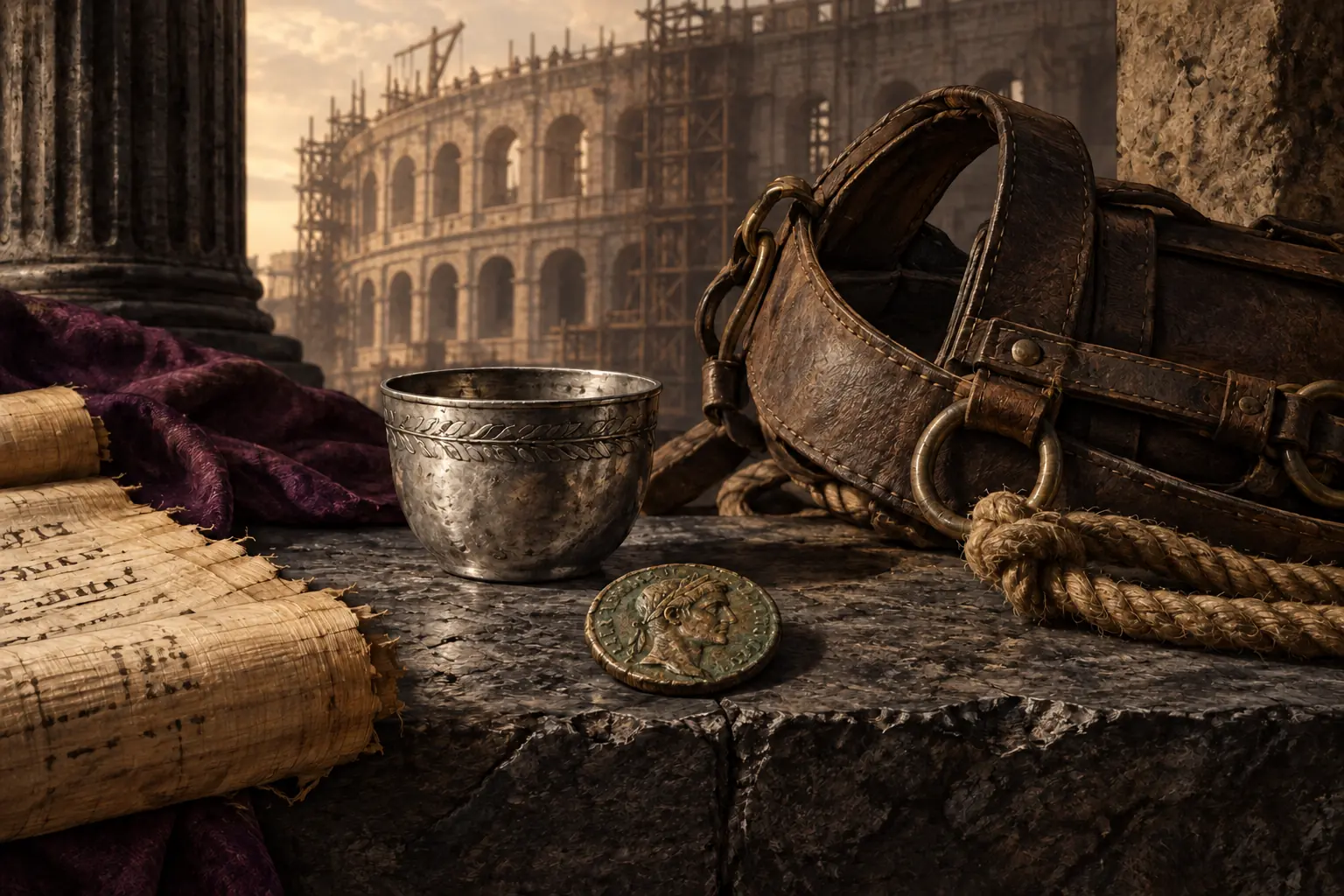
Interpretive still life of a Roman coin, silver cup and mule harness before the early Colosseum
Interpretive artwork: coin, cup and harness bring together three details in Suetonius—the emperor’s finances, his grandmother’s silver cup, and the mule trade—against the Flavian Amphitheatre he began. It is not archaeological evidence.
The private man

He did not erase the road behind him.

Vespasian had climbed farther than Roman society could have expected, but Suetonius gives us a detail more revealing than a triumph. As emperor, he repeatedly returned to the country house where he had been raised by his grandmother. He kept it much as it had been. On festivals, he drank from her little silver cup.

This does not make him gentle, innocent or modern. His rule was financed by hard measures, and ancient biography is never a private diary. Yet the cup offers a crack in the marble. Behind the purple remained the boy formed in a provincial household, the indebted official forced into trade, and the man whose enemies thought “muleteer” could diminish him.

He appears to have answered status with practicality. When someone traced his ancestry to a companion of Hercules, Suetonius reports that he laughed. When urged to put up an expensive monument, he held out his hand and said the base was ready. His humour was not decoration. It was a working tool: a defence against pretension, a way to control embarrassment, and sometimes an excuse for conduct others found undignified.

The quotation audit

What did he say?

Not every familiar line reaches us in the form the speaker used. Each saying therefore carries a verdict—not merely a name.

Verdict · Later condensation
“Money has no smell.”

The famous phrase compresses a scene. Titus objected to a tax associated with urine. Vespasian held a coin from the first payment to his son’s nose and asked whether its smell offended him. When Titus said no, the emperor answered that it came from urine.

Value: a flash of practical reasoning—and a convenient defence of revenue.
Verdict · Reported by Suetonius
“Woe’s me. Methinks I’m turning into a god.”

As death approached, Vespasian mocked the Roman habit of deifying dead emperors. The joke works because its target includes himself: the mortal man watches the machinery of imperial grandeur preparing to swallow him.

Value: humour used against fear, ceremony and self-importance.
Verdict · Reported by Suetonius
“An emperor ought to die standing.”

Suetonius says Vespasian struggled to his feet as he died. Whether remembered exactly or shaped by biography, the line completes the public performance: the working ruler refusing to meet death lying down.

Value: a final act of resolve—and perhaps theatre.
Why it endures

One life. Three uses of speech.

These are not three interchangeable quote cards. Together they disclose a method of survival.

  1. The coin
    Reason turns an embarrassment into policy.
  2. The joke
    Humour punctures the terror and vanity of death.
  3. The last command
    Identity becomes something performed to the end.
  4. The question for us
    Which part of our beginnings should power never be allowed to erase?
Source trail

What can we responsibly claim?

The sayings and biographical details here are attributed to Suetonius, writing after Vespasian’s death. They are reported ancient testimony, not recordings or verbatim transcripts. “Money has no smell” is treated as a later condensation of the episode, not as the sourced wording.

Read Suetonius, Life of Vespasian

Primary passages: Life of Vespasian 1–2, 8–9, 12, 16–24. Editorial principle: where certainty ends, the label changes.