
Vicarii Productions
Who Said That? · Character dossier 004

Marie
Antoinette

“France remembered the sentence she never spoke.”

An Austrian girl became a French queen, then the face of a collapsing system. We place the cake, the necklace and the remembered monster on trial.

Life1755–1793
BornVienna
EvidenceLetters · trial record · Rousseau
FormatFive sayings · six rogues
The girl France remade

A princess reconstructed at the border.

Maria Antonia Josepha Johanna was born in Vienna in 1755, a daughter of Empress Maria Theresa. At fourteen she became the instrument of an alliance and was sent to marry Louis-Auguste, heir to the French throne.

At the border she surrendered Austrian clothes, attendants and possessions before being redressed as a French princess. France did not merely receive the girl. It reconstructed her.

Versailles was a theatre of government. Dressing, dining, childbirth and access to the royal body followed public rituals. The young foreigner was expected to master its factions, charm a husband she scarcely knew, maintain an alliance and produce an heir under relentless observation. She became queen at eighteen.
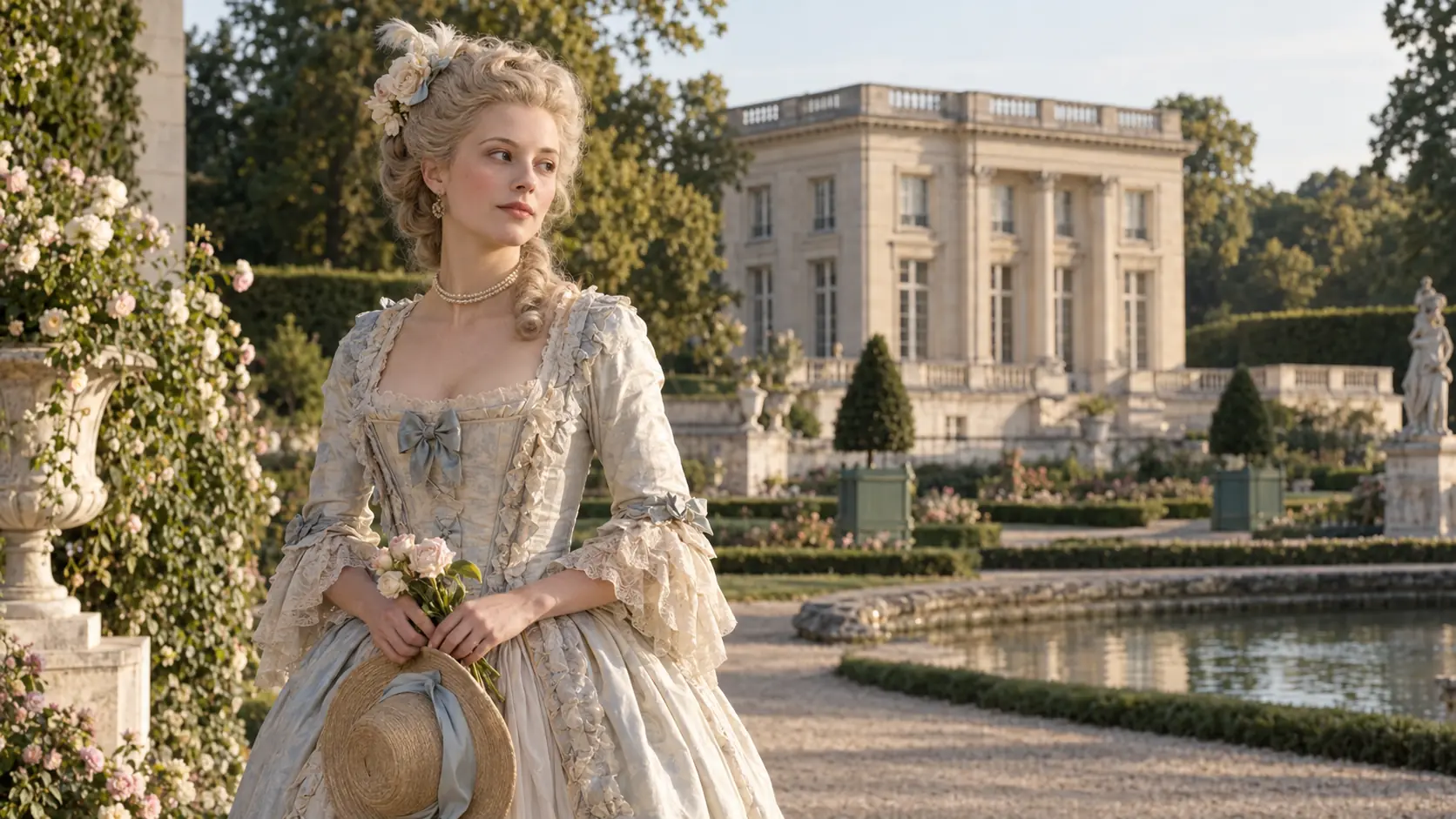
Interpretive portrait of Marie Antoinette in the constrained splendour of Versailles
Interpretive artwork: Marie Antoinette at the Petit Trianon. It evokes the queen’s carefully constructed public image; it is not documentary evidence.
The queen they could see

A national crisis acquired one face.

The gowns, towering hairstyles, gambling, entertainments and Petit Trianon were real. Yet France’s fiscal crisis grew from war debt, borrowing, unequal taxation and the resistance of privileged institutions to reform.

“Madame Déficit” converted economics into character. The Diamond Necklace Affair completed the trick. Marie Antoinette neither ordered nor received the necklace, but the fraud succeeded because an extravagant, dishonest queen already existed in the public imagination.

As revolution advanced she became politically active, corresponded with foreign courts and tried to preserve royal authority. The failed flight to Varennes badly damaged the trust that remained. She did not create the crisis, but she eventually became an actor within it.

The quotation audit

What did she say?

History gave Marie Antoinette the perfect line. Her own correspondence gave us a very different woman.

Imposter
“Let them eat cake.”

Rousseau recorded the answer of an unnamed “great princess.” The French was brioche, not cake, and the passage was written while Marie Antoinette was still a child in Austria.

Jean-Jacques Rousseau, Confessions, Book Six.
Authentic in correspondence
“When people who are suffering treat us so well, we are even more obliged to work for their happiness.”

After unrest over bread prices in 1775, she wrote of obligation rather than contempt. Translations vary; the documentary contrast is secure.

Marie Antoinette, letter of 18 June 1775.
Recorded at the trial
“I appeal to all mothers who may be here.”

Accused of incest with her son, she appealed to the mothers present. The hostile courtroom briefly reacted to the woman beneath the political identity.

Proceedings of the Revolutionary Tribunal, October 1793.
Authentic document
“I have just been condemned, not to a shameful death… but to go and rejoin your brother.”

She declared herself innocent, asked forgiveness and urged her children never to seek revenge. The letter was intercepted.

Final letter to Madame Élisabeth, 16 October 1793.
Famous but not proven
“Pardon me, sir. I did not do it on purpose.”

The alleged apology after stepping on the executioner’s foot is plausible and human, but its evidential trail is not strong enough for authentication.

Traditional attribution; case not proven.
The rogues’ gallery

Evidence for the prosecution?

Some exhibits reveal the queen. Others reveal the character France needed her to be.

“Let them eat cake.”

Rousseau’s unnamed princess; Marie Antoinette was still a child in Austria.

“Let them eat brioche.”

Closer to Rousseau’s French, but still not evidence against Marie Antoinette.

“Pardon me, sir…”

A famous reported last remark without a sufficiently firm near-contemporary chain.

“There is nothing new except what has been forgotten.”

Frequently assigned to her; the exact documentary trail requires caution.

Pamphlet dialogue and sexual claims

Evidence of propaganda and reputation, not dependable transcripts of speech.

The necklace as proof of extravagance

She neither commissioned nor received the diamond necklace used to ruin her name.

What survives the filter

Neither saint nor slogan.

The record gives us a privileged queen, a political actor and finally a prisoner whose most direct words concern motherhood, forgiveness and death.

  1. Separate the system from its symbol
    One visible person can carry the blame for a failure larger than any individual.
  2. Do not replace caricature with acquittal
    Propaganda can be false while political mistakes remain real.
  3. Test the memorable line
    A perfect quotation is often perfect because history polished it.
  4. Listen to the surviving voice
    Her last letter asked her children not to avenge their parents.
Source trail

What can we responsibly claim?

The cake anecdote appears in Rousseau before Marie Antoinette could plausibly have supplied it. Her correspondence, trial record and final letter provide a stronger route to her actual voice.

Read Rousseau’s Confessions
Explore the Versailles correspondence project →
Library of Congress research guide →

Editorial principle: sympathy does not lower the standard, and hostility does not become evidence.